


Introduction
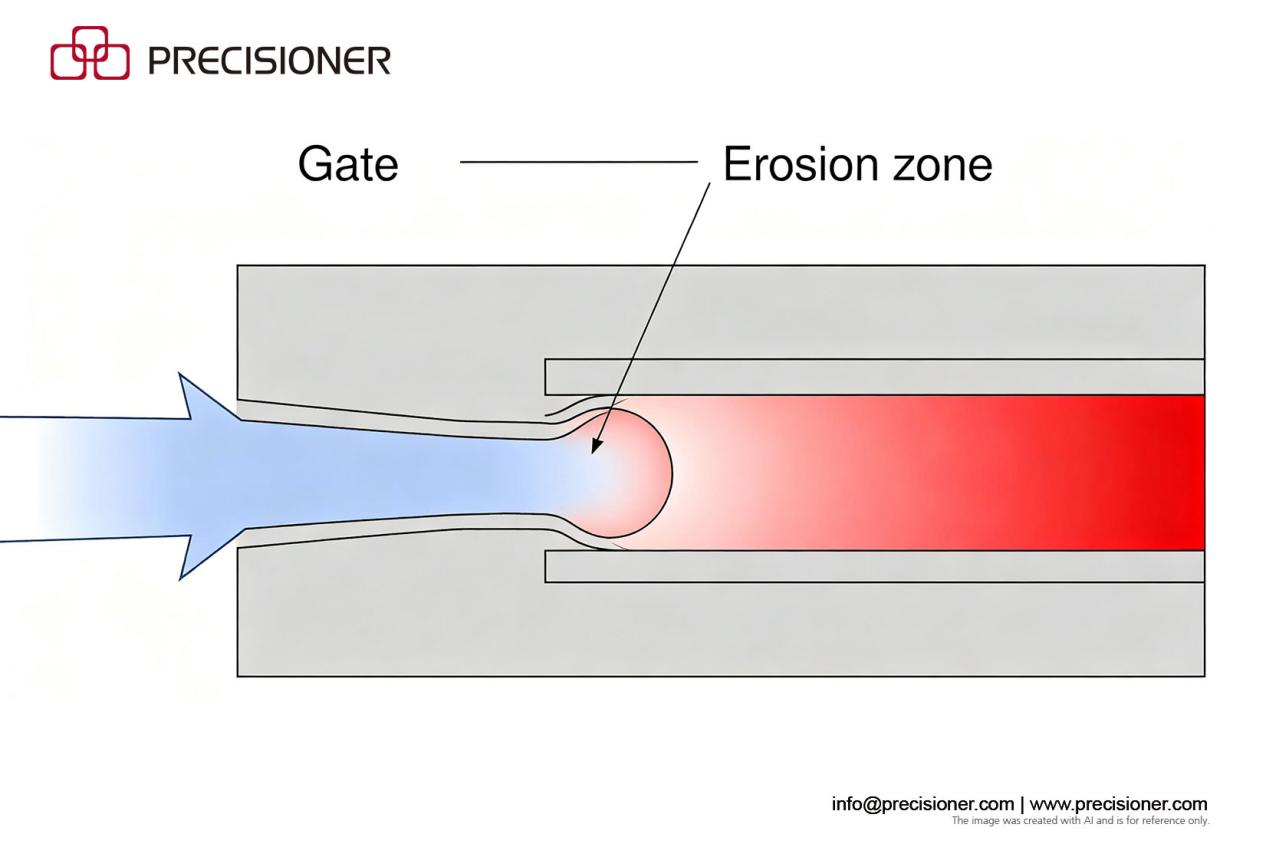
Most mold designers know that higher gate velocity accelerates erosion. What is less understood is the scale of the effect. If you reduce gate velocity by 11%, how much does erosion actually drop?
Not 11% — typically 30% to 40%.
Erosion scales non-linearly with velocity — the relationship follows a power law with an exponent between 2.5 and 3.5. In other words, a relatively small reduction in gate velocity yields an exponential improvement in tool life.
Body
Erosion depth and gate velocity follow a power-law relationship:
ER ∝ v_gate^α
The exponent α typically falls between 2.5 and 3.5, depending on the alloy and the tool steel grade. The implication is significant: even modest reductions in gate velocity can substantially reduce erosion.
Measured data from Precisioner (H13 tool steel, A380 aluminum alloy, measured at 5,000-shot intervals):
v_gate = 55 m/s → erosion depth: 0.32 mm per 10,000 shots → estimated tool life: 55,000 shots
v_gate = 45 m/s → erosion depth: 0.13 mm per 10,000 shots → estimated tool life: 135,000 shots
v_gate = 38 m/s → erosion depth: 0.06 mm per 10,000 shots → estimated tool life: 310,000 shots
Velocity reduction design method
A practical way to reduce gate velocity is to split the total flow across multiple gates. If the total gate area is A_total, and each gate has area A_gate, then the number of gates is n = A_total / A_gate. The velocity at each gate is v_gate = Q / (n · A_gate), where Q is the volumetric flow rate. Increasing n reduces individual gate velocity linearly, which in turn lowers erosion exponentially.
Constraints
Precisioner Reference Database
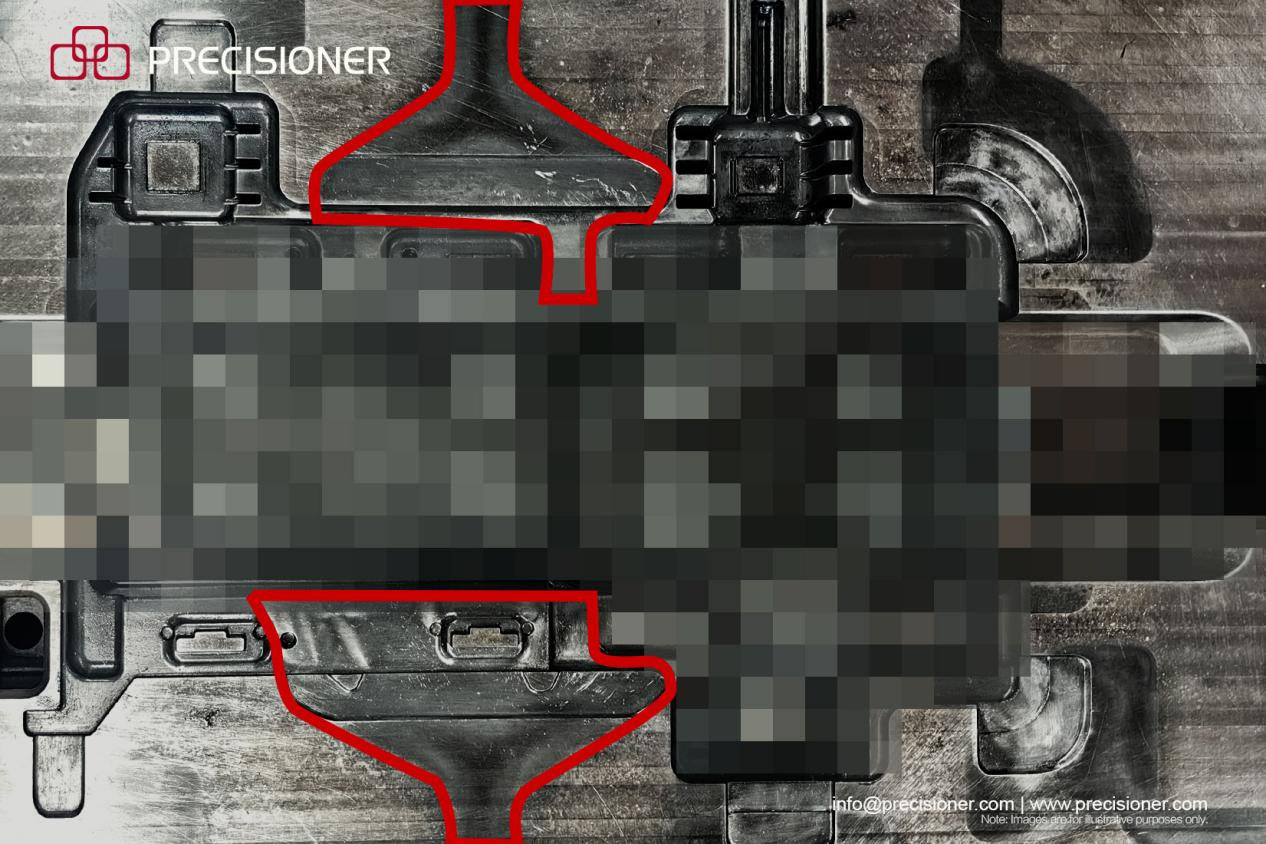
We have found that dropping gate velocity from 45 m/s to 38 m/s significantly extends tool life. What velocity range do you typically use?
info@precisioner.com