



A slide with a guide width of 300 mm will expand by approximately 0.72 mm across its width under a 200 °C temperature rise. If the cold fitting clearance is less than 0.1 mm and the guide housing expands by less than the slide, interference and jamming will occur under thermal conditions. This is not a theoretical exercise—it is a direct consequence of physical law.
Many slide jamming issues in molds are not caused by insufficient lubrication, but by inadequate allowance for differential thermal expansion between the slide and its guideway. This article provides calculation methods for thermal clearance, wave spring compensation strategies, material selection guidelines for self-lubricating components, and presents measured data from a 6,600-ton mold—demonstrating a 62% reduction in jamming rate.
Body:
The thermal expansion of a slide is given by the linear expansion formula:
ΔL= α ⋅ L ⋅ ΔT
For H13 tool steel, α = 12 × 10⁻⁶ /°C
Slide operating temperatures typically range from 180 °C to 250 °C. With assembly at room temperature (~25 °C), ΔT ranges from approximately 155 °C to 225 °C; a typical working ΔT of 200 °C is used for conservative estimation.
important: Jamming is caused by thermal growth across the guide fit dimensions (width or thickness), not along the slide's length direction. Lengthwise expansion affects stroke and angle-pin loading, but not guide clearance directly.
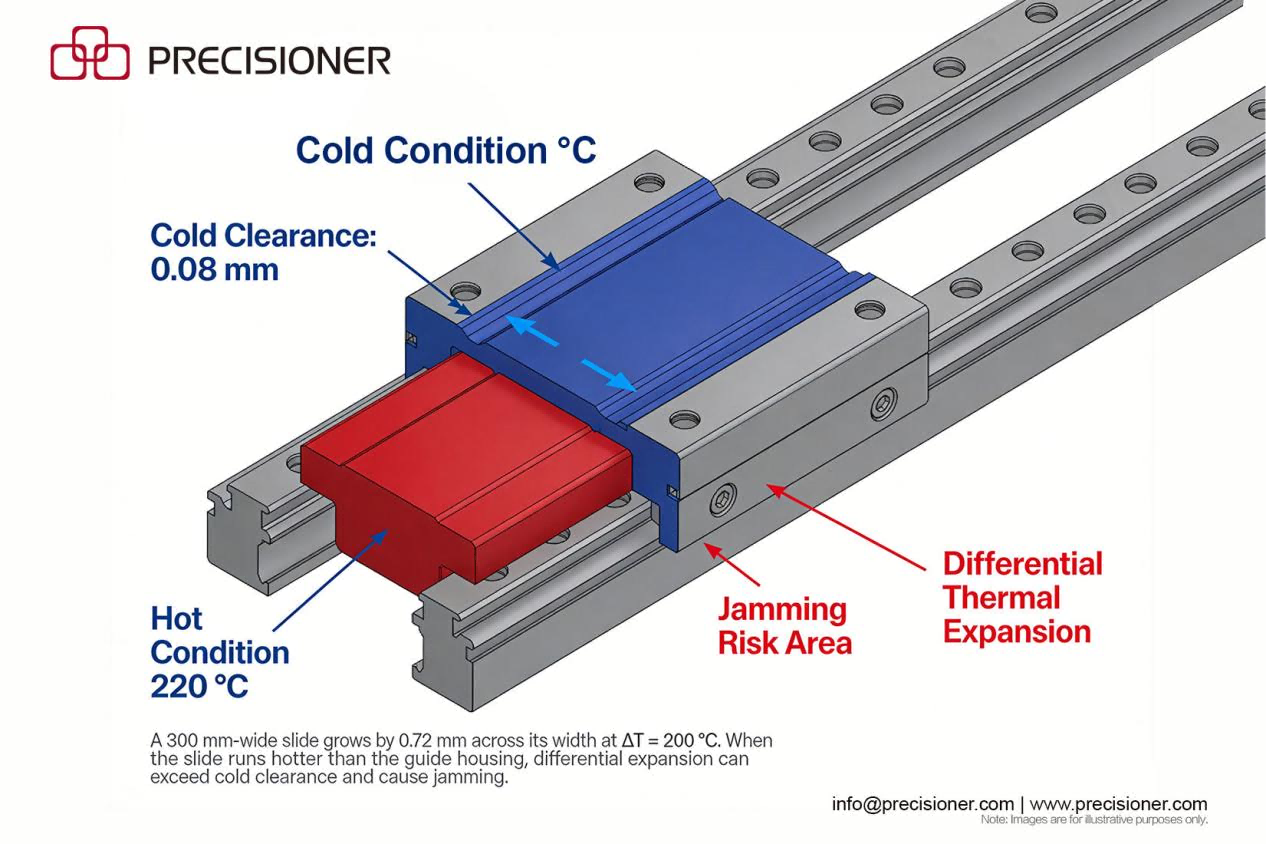
For a slide with a guide width W = 300 mm, the thermal growth ΔW = α · W · ΔT = 0.72 mm. In practice, the guide housing (mold frame) also expands. The net clearance change depends on the differential expansion between slide and guideway:
Δg = ΔW_slide − ΔW_guide
Compensation Strategies:
1.Provide thermal clearance:
g_cold,min = g_hot,min + (ΔW_slide − ΔW_guide)
Cold clearance (per side) is typically set to 0.15–0.25 mm, based on 300 mm guide width and ~100 °C differential (compared to 0.03–0.08 mm per side for conventional molds).
2.Single-side guideway contact:
Maintain contact on only one guide face, leaving a 0.3–0.5 mm gap on the opposite side.
3.Elastic preloading:
Install wave springs between the wear plate and the slide base to provide preload and automatically compensate for thermal expansion.
Self-Lubricating Material Selection
Material
Max Temp.
Friction μ
Application
Graphite-embedded copper alloy
400 °C
0.10–0.15
Low-speed, heavy-load
MoS₂ solid lubricant coating
350 °C
0.05–0.08
Medium-speed, medium-load
WS₂ solid lubricant coating
450 °C
0.05–0.08
High-speed, light-load, high temp
Note: Conventional high-temperature grease carbonizes above 250 °C and should therefore be avoided in slide guide applications with operating temperatures above 200 °C.
Measured Data
A core-pulling slide in a 6,600-ton mold, with a guide width of 300 mm, length of 450 mm, and operating temperature of 220 °C, was originally designed with a cold clearance of 0.08 mm and lubricated with conventional grease.
Before optimization: Jamming occurred at an average rate of 1.56 times per hour, making continuous production impossible.
After modification:
1. Cold clearance increased to 0.22 mm
2. Graphite-embedded wear plates installed
3. Water cooling added to the slide core, reducing operating temperature to 170 °C
Result:
Jamming rate dropped to 0.59 times per hour — a 62% reduction — and the mold could run sustained production shifts without interruption.

— Precisioner Engineering Team
We find slide jamming in large molds particularly challenging — how do you address it in your operations?
info@precisioner.com