



Introduction
Vacuum systems in high-pressure die casting are often treated as a checkbox item — as long as vacuum is present, the job is done. But vacuum technology is not a simple on/off switch. How it is applied, and where it is applied, determine whether it solves porosity or simply adds cost.
This article is not about whether vacuum is good — the structural die casting industry has already reached consensus on that. What we will discuss is this: why do some production lines, all equipped with vacuum systems, reduce internal porosity to below 0.5% and achieve blister-free heat treatment — while others spend the money and see barely any improvement?
Porosity in high-pressure die casting originates from two fundamentally different sources:
Gas Porosity from Air Entrainment
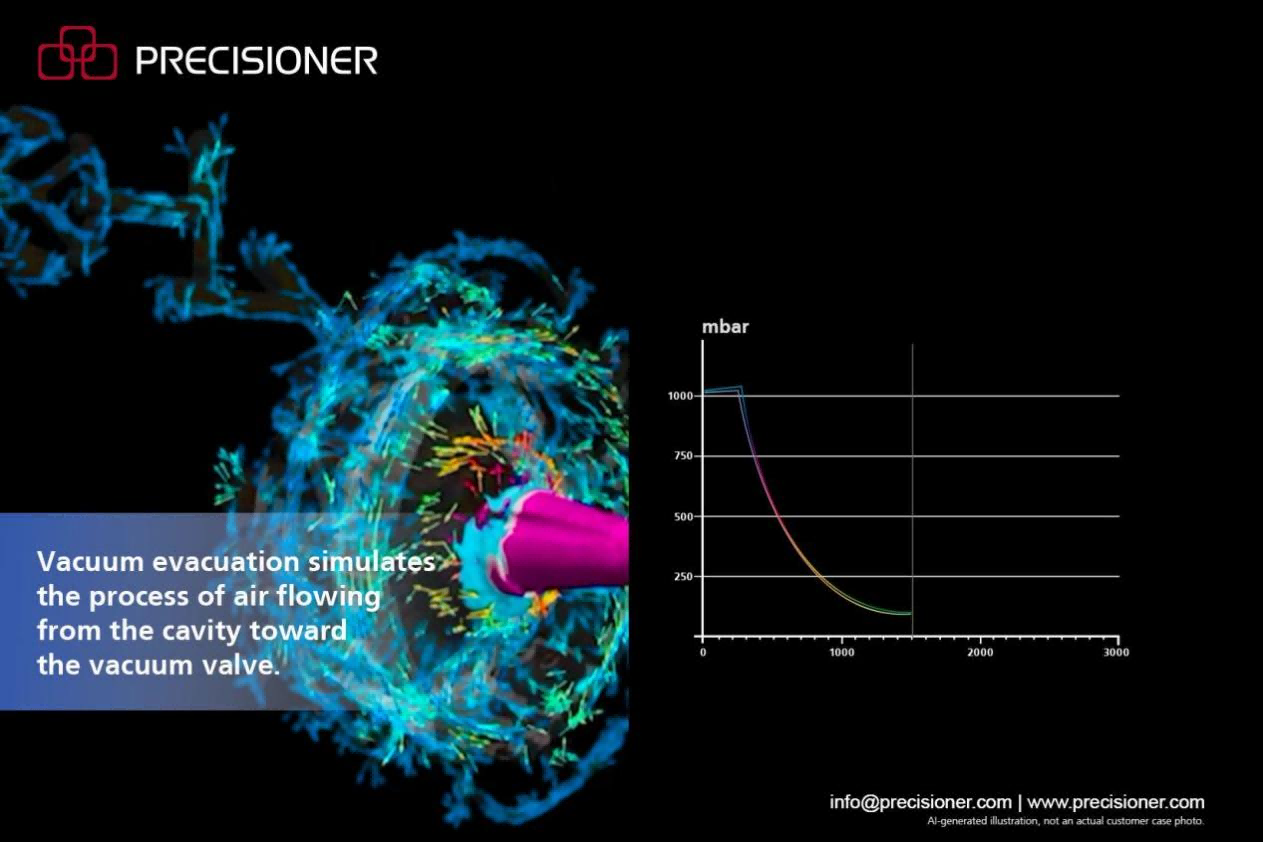
During cavity filling, turbulent metal flow entrains air, or residual gas in the cavity is not evacuated in time. Both become trapped inside the casting as pores. The primary function of a vacuum system is to evacuate cavity air before filling begins, reducing gas entrainment at the source.
Shrinkage Porosity from Solidification
As molten metal solidifies, it contracts in volume; regions with inadequate feeding form voids. These defects have nothing to do with air — increasing vacuum level or installing a larger pump will not fix shrinkage porosity. The correct response is to redesign the gating system, optimize cooling layout, or adjust alloy composition.
02 Effective vs. Ineffective Vacuum: Four Guiding Principles
To tell whether a vacuum system is truly effective or just cosmetically present, these four principles are all you need.
Principle 1: Timing Matters as Much as Vacuum Level
At Precisioner, vacuum valve triggering is precisely calibrated based on when the melt front reaches the gate in flow simulation — not set by experience. The timing sequence is individually calibrated for every die.
Principle 2: Vent Location Matters as Much as Pump Capacity
Achieving 50 mbar at the pump means very little if the vacuum vent is positioned where the metal arrives first — the vent gets sealed off by molten metal before vacuum can take effect.
Vent layout must be determined by filling simulation results, positioned where gas finally accumulates — not placed wherever is most convenient on the die drawing.
Principle 3: Seal Condition Determines Real-World Performance
At Precisioner, seal replacement is enforced by shot-count cycles — we don’t wait until leakage is visible. Preventive maintenance costs far less than corrective maintenance.
Principle 4: Hydraulic Vacuum Valves Are Replacing Mechanical Valves as the Production Standard
Hydraulic vacuum valves cut response time from approximately 80 ms (traditional mechanical valves) to approximately 30 ms, with significantly improved sealing consistency. For structural components requiring T6 heat treatment, this tens-of-milliseconds difference often determines whether porosity stays within acceptable limits — and whether casting surfaces blister after solution treatment.
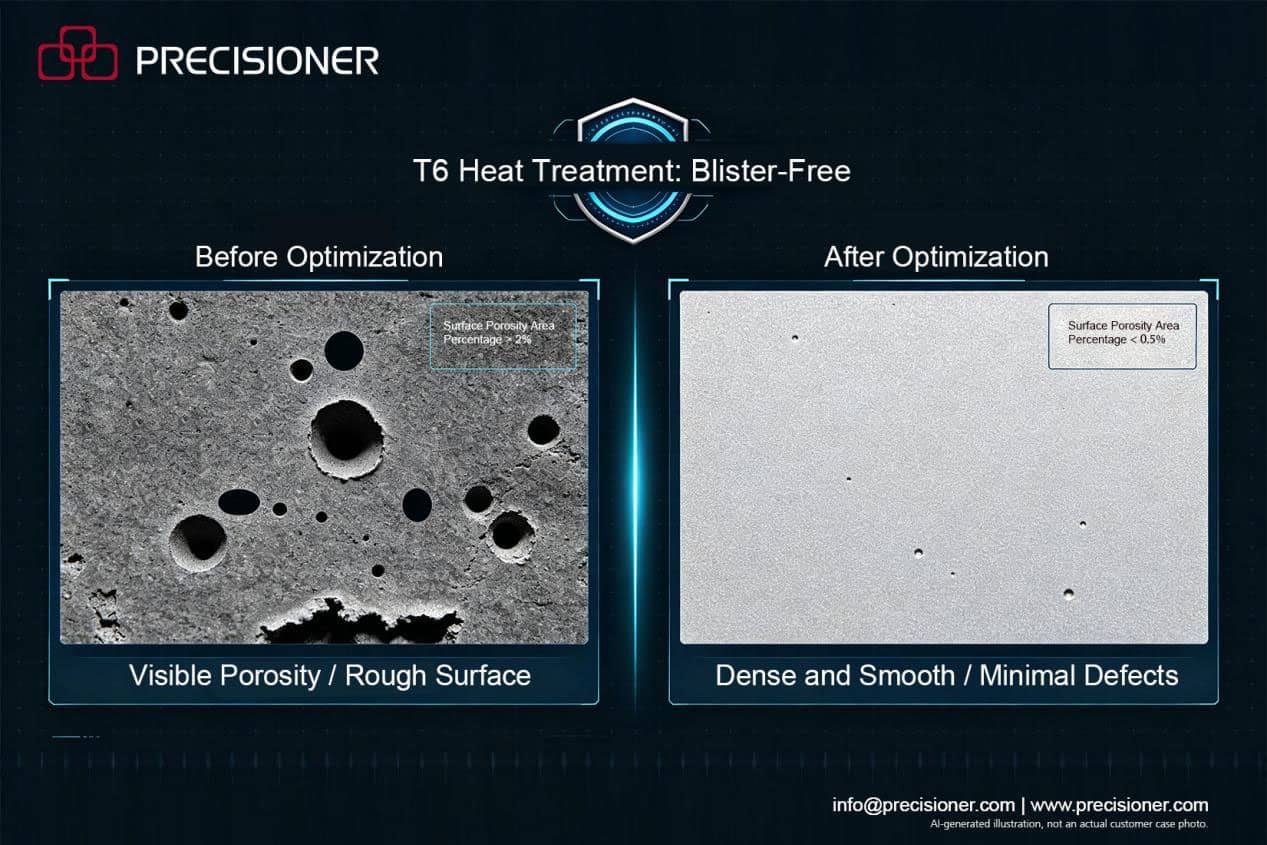
On structural die castings requiring T6 heat treatment, gas porosity is the primary cause of surface blistering during solution treatment. Trapped air expands at high temperature, rupturing the oxide skin and forming visible blisters on the casting surface.
In projects where vacuum design follows the methodology above, we have reduced surface porosity area percentage ratio from above 2% to below 0.5% — making T6 heat treatment feasible without blistering.
In projects where vacuum was a retrofit add-on — with casually positioned vents and seal maintenance dependent on visual inspection — the equipment was present, but porosity improvement was negligible.
For structural and safety-critical components, vacuum-assisted die casting has already shifted from a premium option to a baseline requirement. The larger and more complex the casting, the more gas gets entrained during filling. Without an effective vacuum system, porosity issues are statistically almost unavoidable.
The EV boom is accelerating this trend — large structural components such as mega-casted rear floors, battery housings, and motor housings demand far tighter porosity control and heat treatability than traditional die castings. Vacuum system design capability is becoming one of the core competencies that differentiate die casting mold suppliers.
Vacuum is not a silver bullet. But for structural die casting, you simply cannot do without it.
If your production line struggles with porosity or heat treatment blistering, the problem may not be the alloy or the casting machine — it may be how your vacuum system is designed and maintained.
Precisioner offers full-tonnage die trial services from 300 t to 6,600 t, with vacuum system design and process validation built into every trial program. We welcome technical discussions on vacuum-related challenges with your engineering team.
Precisioner Engineering Team