



Introduction
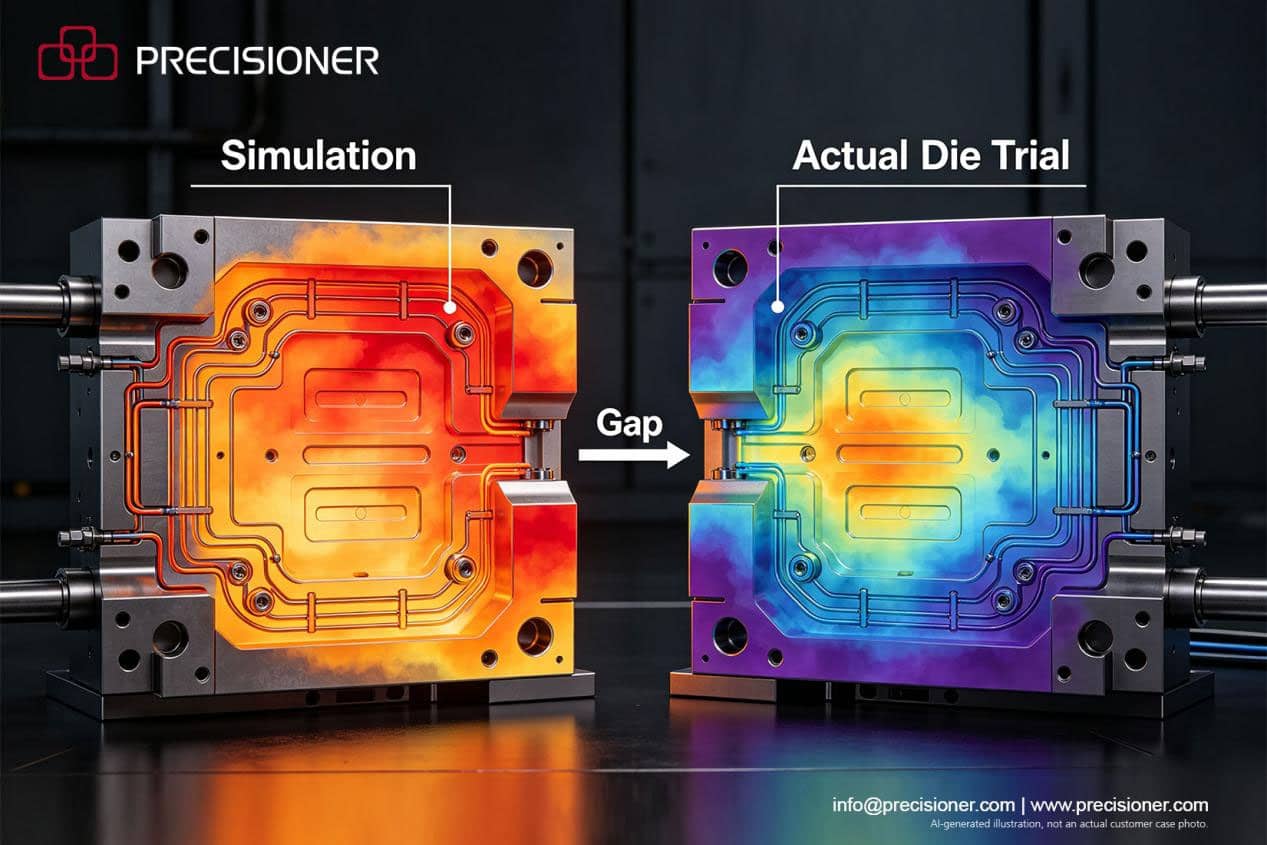
“The simulation never matches reality.” — nearly every die casting engineer has heard this. More often than not, the problem isn't the software — it's the boundary conditions.
Body
In thermal simulation of high-pressure die casting, the Interfacial Heat Transfer Coefficient (IHTC) between the casting and the die surface is the single most influential parameter governing thermal profile, solidification sequence, and shrinkage porosity prediction. Yet it is also the parameter most frequently left at software default values.
Default IHTC values in simulation software typically fall between 5,000–8,000 W/(m²·K).
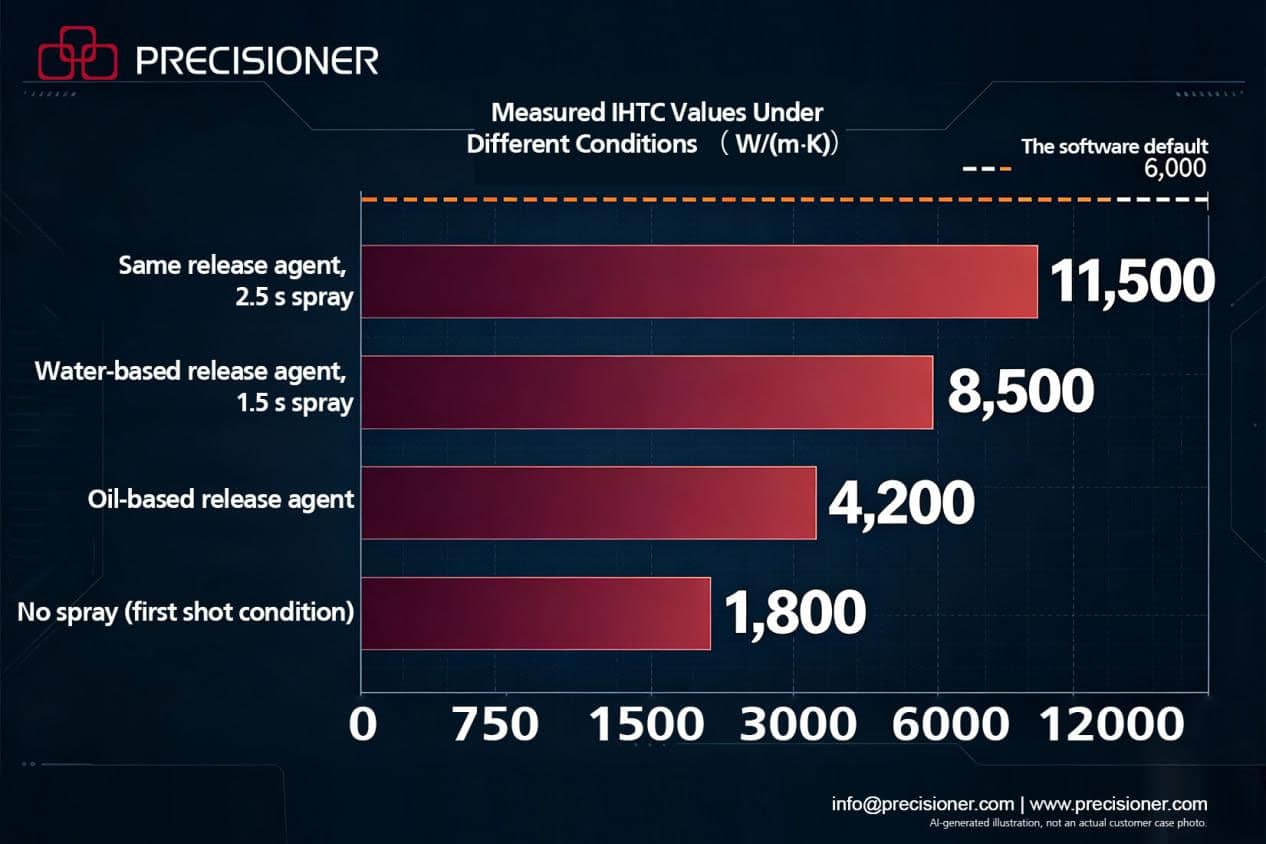
Measured IHTC Values Under Different Conditions
· Water-based release agent, 1.5 s spray: ~8,500 W/(m²·K)
· Same release agent, 2.5 s spray: ~11,500 W/(m²·K)
· Oil-based release agent: ~4,200 W/(m²·K)
· No spray (first shot condition): ~1,800 W/(m²·K)
For the water-based release agent tested, extending spray time from 1.5 s to 2.5 s increased IHTC by approximately 35%. If the simulation is run with the default value, the resulting thermal profile deviation can significantly reduce the accuracy of predictions for shrinkage location, solidification sequence, and cooling efficiency.
With default IHTC values, shrinkage porosity location predictions can deviate by 5–15 mm, depending on part size and geometric complexity. In an actual automotive structural component project, the initial simulation predicted shrinkage at the root of a rib — but X-ray inspection revealed the porosity was offset by a full 15 mm.
What does 15 mm mean in the die casting industry? It means an entirely different die repair strategy — what could have been a simple insert adjustment may instead require a complete re-layout of cooling lines. What could have been resolved in one trial iteration may drag on for three or more. Both time and tooling modification costs escalate from this single point of deviation.
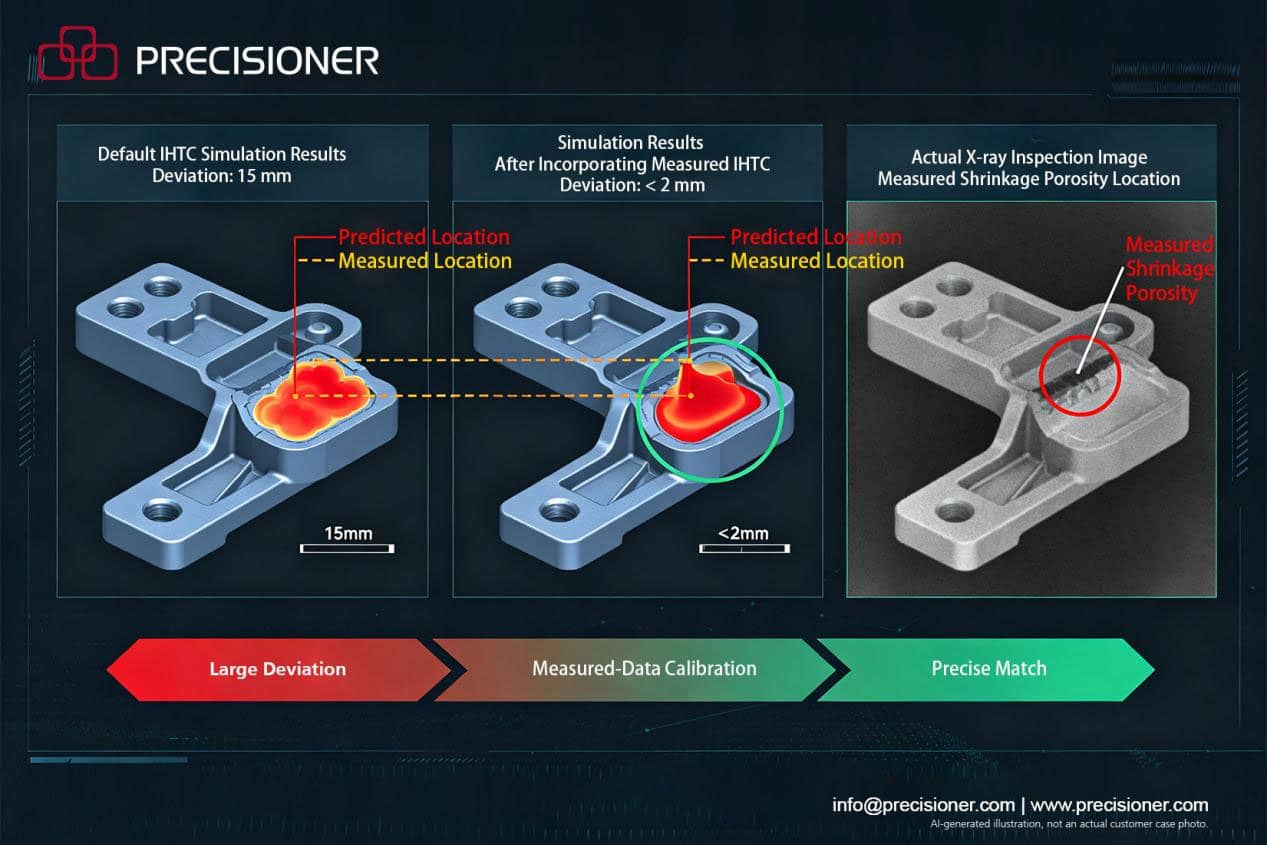
The answer is not to switch software — it is to anchor simulation in real production data. In the case above, we embedded thermocouples at critical die locations, captured temperature curves across a full production cycle, and back-calculated the actual IHTC: 9,500 W/(m²·K), not the software default of 6,000 W/(m²·K).
When the measured value of 9,500 W/(m²·K) was plugged into the simulation model, the second-round shrinkage prediction closely matched X-ray inspection results, with deviation controlled to
within 2 mm. Cooling line layout was then adjusted based on the corrected simulation — and the first trial batch passed inspection.
Conclusion
Measured data from real production — not software defaults — is the most reliable foundation for simulation accuracy. The industry is evolving from experience-driven to data-driven engineering. Every simulation should be anchored in measured boundary conditions.
Precisioner has accumulated 6,000+ sets of measured IHTC data from hundreds of dies under real production conditions. These are not just numbers sitting in reports — they are fed directly into the simulation workflow for every new project. Predictions start from measured data, not from software defaults.
If your simulation results consistently diverge from actual casting data, the problem may not be the software — it may be the boundary conditions.
info@precisioner.com
Precisioner Engineering Team